Correlation in R” custom_color=”#ffffff”][advice_space large_desktop_space=”5″ desktop_space=”5″ tablet_space=”5″ landscape_mobile_space=”10″ mobile_space=”10″][advice_text_block font_weight=”400″ color=”custom” custom_color=”#ffffff” css=”.vc_custom_1666770851538{margin-top: 10px !important;}”]
Looking for a Pearson Correlation in R? Doing it yourself is always cheaper, but it can also be a lot more time-consuming. If you’re not good at R programming, you can pay someone to do your R task for you.
[/advice_text_block][advice_space large_desktop_space=”5″ desktop_space=”5″ tablet_space=”5″ landscape_mobile_space=”10″ mobile_space=”10″][advice_button align=”left” shape=”rounded” text=”Get a FREE Quote Now!” link=”url:http%3A%2F%2Fwww.staging.onlinespss.com%2Fsubmit-your-project%2F|title:Submit%20Your%20Statistics%20Project-Homework-Assignment||”][advice_space large_desktop_space=”5″ desktop_space=”5″ tablet_space=”5″ landscape_mobile_space=”10″ mobile_space=”10″]

What is a Pearson Correlation Analysis?
Correlation describes the strength and direction of the linear relationship between two variables. Pearson’s correlation coefficient is used for interval variables, and Pearson’s correlation coefficient can only take values from -1 to +1. The sign indicates whether the correlation is positive (both variables decrease or increase) or negative (one variable decreases when the other increases and vice versa). A perfect correlation, 1 or -1, indicates that the value of one variable can be accurately determined when we know the value of the other. A correlation equal to 0 indicates no relationship between the two variables.
When Should a Pearson Correlation be Used?
An Example Of Pearson Correlation Test
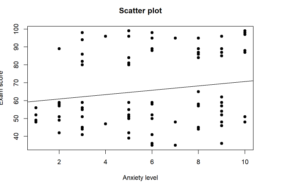
For example, a teacher wants to examine the relationship between the level of anxiety and the exam score. Then we have two variables: the level of anxiety and the exam score.
What are the use of null and alternative hypothesis for the correlation analysis?
Therefore, we test the following hypotheses:
Null hypothesis: There is no significant effect relationship between the level of anxiety and exam score.
Alternative hypothesis: There is a significant effect relationship between the level of anxiety and exam score
R function to Compute Pearson Correlation
The code to run a Pearson Correlation Analysis using R is as follows:
cor.test (x, y, method=(“pearson”, “kendall”, “spearman”), data = dataframe)
x, y: numeric vectors with the same length
method: correlation method
In this section, we will show you how to run the Pearson correlation analysis using the r studio program and how to interpret the test results after we obtain the result of the test. In the first part, we present the r program code and function for the correlation analysis. Next, you will see the outputs as a result of running the r codes. In the last section, you can find the interpretation of the Pearson correlation in APA format.